

Complaints and Escalation
You do not have to stay trapped in a loop of vague replies, delay, and unresolved concerns. A complaint is often the first serious step toward accountability. When the factor does not answer the real issue, refuses to resolve it, or drags matters out unreasonably, homeowners need to know how to move from complaint to escalation properly.
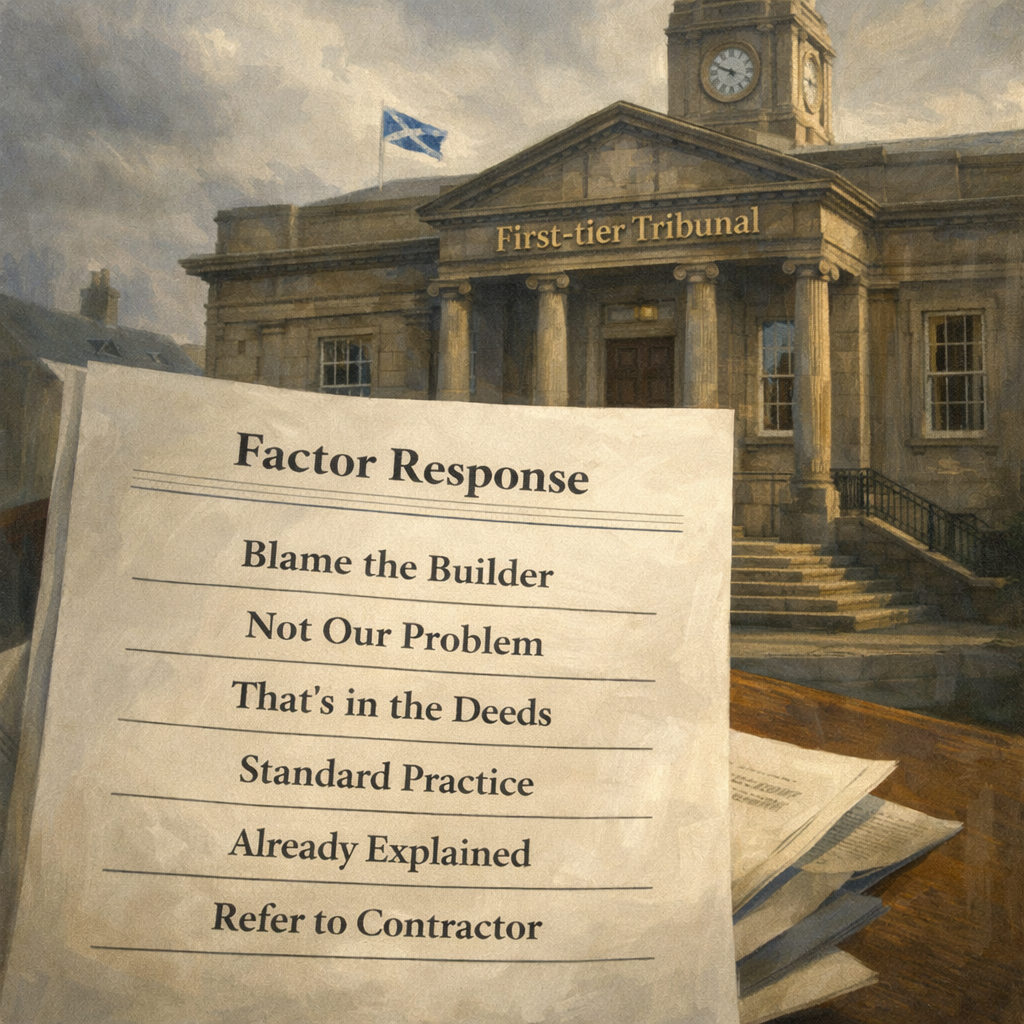
Why complaints matter
Many homeowners spend too long trying to “sort things out informally” while the real issue keeps drifting. A proper complaint changes that. It puts the problem into a form that should be answered clearly, creates a record, and begins to define whether the factor is actually engaging with the issue or simply deflecting it.
A complaint is often the first real turning point
Once a complaint is made clearly in writing, the factor can no longer rely on the issue remaining vague, verbal, or loosely defined. The homeowner has set out the concern in a way that can later be evidenced and measured.
It is also a test of the factor’s response
A factor’s complaint response often reveals a great deal. Does it address the issue directly, or dodge it? Does it explain, or simply repeat a position? Does it resolve, or just delay?
When a problem becomes a complaint
Not every problem starts as a formal complaint. But many become one when the factor’s response stops being clear, practical, or fair.
The factor should have a written complaints procedure
Homeowners should not have to guess how to complain. A factor should have a written complaints procedure explaining how complaints are made and how they are handled.
You should be able to find out
- where complaints should be sent
- whether email is accepted
- who deals with the complaint
- whether there is more than one stage
- what timescale the factor says it will respond within
- what happens if the complaint is not upheld
If you cannot find it easily
That is itself a concern. Homeowners should not be left searching blindly for how to complain while the issue continues. The complaints route should be clear, usable, and accessible.
Why complaints should be made in writing
If you later need to escalate, written communication becomes critically important. A proper written complaint makes it much easier to show what was raised, when it was raised, and how the factor responded.
Good practice
- use email where possible
- set out the complaint in numbered points
- attach or refer to the most important documents
- ask for a reply within a reasonable period
- keep copies of everything sent and received
Why it matters
If it is not clearly set out in writing, it becomes much harder to prove later. A vague verbal objection is not the same thing as a documented complaint with dates, facts, and evidence behind it.
What a strong complaint should include
A strong complaint does not need to be legalistic, but it does need to be clear, factual, and focused.
What outcome should you ask for?
Many homeowners know what is wrong, but not what to ask for. A complaint should not stop at saying “I am unhappy.” It should say what you want the factor to do about it.
You may be asking for
- a clear written explanation
- production of missing documents
- a correction of inaccurate information
- a revised bill or recalculation
- a proper repair plan or response
Or you may be asking for
- a proper complaints response to specific questions
- confirmation of the factor’s position in writing
- correction of records
- an explanation of why a charge is said to be recoverable
- a complaint outcome that can be assessed clearly
Complaint and escalation are not the same thing
This distinction matters. A complaint is made to the factor first. Escalation comes later if the factor refuses to resolve the concern or unreasonably delays attempting to do so.
The complaint stage
This is where you define the issue clearly, set out why you say the factor is wrong, attach the key documents, and ask for a specific outcome.
The escalation stage
This is where the written complaint, the factor’s response, the delays, and the evidence trail become crucial. Escalation works best when the complaint stage has been done properly.
Refusal and unreasonable delay both matter
A factor does not have to say “we refuse” in those exact words for escalation to become relevant. Sometimes the issue is unresolved because the factor simply drags it out or avoids the real point.
Look out for:
- no reply within the factor’s own stated timescale
- repeated holding responses with no real progress
- answers to a different issue from the one you raised
- refusal to address the key complaint point
- requests for information being ignored or endlessly deferred
- the matter being dragged out without meaningful action
Common mistakes that weaken complaints
A good complaint can still be weakened by avoidable mistakes. Knowing what not to do is often just as useful as knowing what to do.
Evidence and chronology make complaints stronger
A complaint becomes much easier to understand when the documents tell the story in order.
Useful documents to keep
- complaints emails and letters
- the factor’s replies
- invoices and statements
- photographs
- repair reports or insurance documents
- notes of dates and events
Why this matters
A good complaint is easier to prove when the chronology is clear. Dates, documents, and evidence make it much harder for the issue to be blurred, rewritten, or dismissed as confusion.
A practical journey from complaint to escalation
Try to think of the process as a route-map. Doing each step properly makes the next one stronger.
1. Identify the issue
Be clear about what has gone wrong and why you say it matters.
2. Gather the documents
Pull together the key invoices, letters, emails, photos, and supporting records.
3. Complain in writing
Set out the complaint clearly, factually, and with a specific outcome you want addressed.
4. Follow the procedure
Use the factor’s complaints route, note the timescales, and keep the replies.
5. Record refusal or delay
If the factor will not resolve it, or drags it out unreasonably, make a note of that pattern.
6. Escalate if needed
Prepare a clear chronology and documentary trail before taking the matter further.
Before escalating, ask yourself
These questions help test whether the complaint stage has been done strongly enough.
The Tribunal route
If the factor refuses to resolve the concern or unreasonably delays, a homeowner may be able to apply to the First-tier Tribunal for Scotland (Housing and Property Chamber). That is why the written complaint stage is so important.
Why preparation matters
- you will need the written complaint trail
- you may need the Written Statement of Services
- you should be able to show what the issue was and how the factor responded
- clarity and chronology matter
Your Right To Clear Information
Escalation becomes much stronger when the original issue was set out clearly and the lack of proper answer can be shown in writing.
Stay firm, factual, and clear
Complaints are easier to follow and harder to dismiss when they are structured well. This does not mean your frustration is invalid. It means clarity gives your complaint more force.
Good approach
- be firm, but stay factual
- use dates and documents
- separate the issues clearly
- quote or refer to what was actually said or billed
- keep the complaint measured and focused
Share Your Story
Complaints often become more powerful when homeowners compare responses, identify patterns, and realise they are not facing the issue alone.
When excuses replace answers, escalation matters
You do not have to accept a complaints process that goes nowhere. If the issue has been clearly raised, the factor has been given the chance to deal with it, and the response is still refusal, evasion, or unreasonable delay, the next step may be to escalate with your evidence in order.